Forming Community: How Coral Reefs and People Create Lasting Global Impact
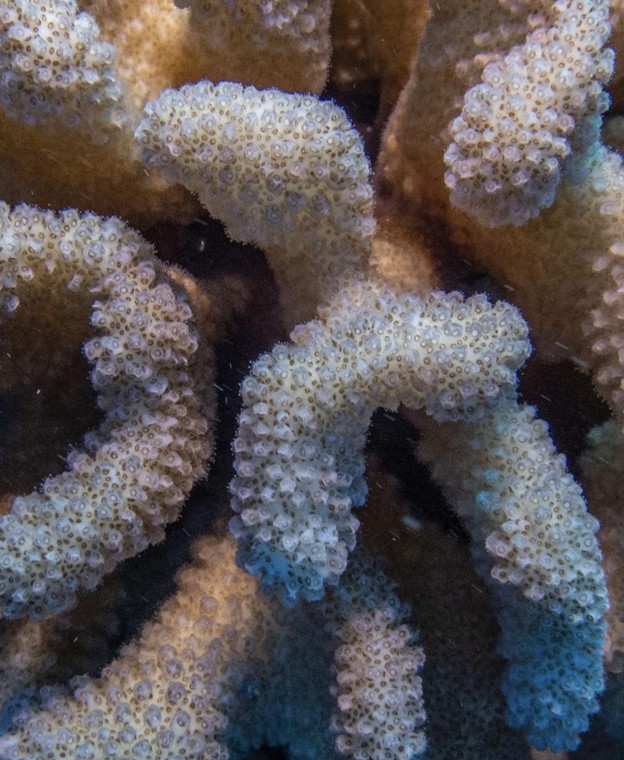
Here in Hawaii coral and reefs are more than a resource, they’re considered the beginning of everything. In Hawaiian culture there is a 2000 line epic that passes down the lineage of all things from the beginning of time all the way through to chiefly lineages. This chant is called the Kumulipo, the Hawaiian creation chant.
The first creature to come into existence is a coral polyp.
….
0012. Hanau ka po
The night gave birth
0013. Hanau Kumulipo i ka po, he kane
Born was Kumulipo in the night, a male
0014. Hanau Po‘ele i ka po, he wahine
Born was Po‘ele in the night, a female
0015. Hanau ka ‘Uku-ko‘ako‘a, hanau kana, he ‘Ako‘ako‘a, puka
Born was the coral polyp, born was the coral, came forth
…
It’s not a coincidence that ancient Hawaiians saw a coral polyp as the foundation of life, because for 25% of the world’s marine life, they are.
Whether you live near the ocean or in a land locked state, most people have heard of coral reefs and seen stunning images of thousands of fish shimmering over a rainbow garden. We’re told coral reefs are important and to even wear special “reef safe” sunscreen to save it, but why?

Photo credit: Adam Palmer, Kuleana Coral Restoration.
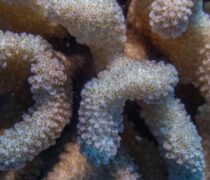
Corals are invertebrate closely related to anemone and jellyfish. They can be found around the world from as shallow as a few inches below the surface, down to 20,000 feet below in the dark icy depths. But what most don’t know is that the coral itself is a tiny soft bodied polyp. It’s when thousands of these polyps come together to form colonies housed in stone-like structures that we see the iconic structure most people think of when they hear the word “coral.”
One of the truly remarkable abilities of coral is their ability to reproduce both sexually and asexually. If a coral is broken, it can clone itself and expand its cover or even create a new colony. All of these qualities and adaptations are what enable these incredible tiny creatures to become an integral part of our ocean ecosystem. But when coral is destroyed faster than they can reproduce we threaten the balance of the symbiotic relationship with the ecosystem around them.
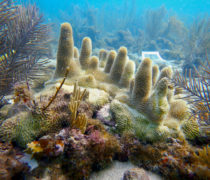
Coral reefs make up just 1% of the world’s ocean floor but host about a quarter of the world’s marine life, equating to hundreds of thousands of species from microorganisms to whales. Our economies also depend on thriving coral reefs, with more than half of U.S. fisheries relying on them for healthy populations of lobsters, clams, snappers and groupers all the way to mahi-mahi, tuna and billfish.
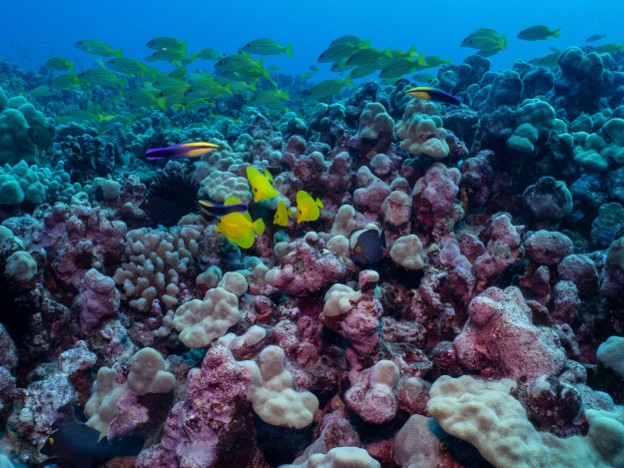
Photo credit: Kuleana Coral Restoration
The structures that corals build even influence the movement of the ocean. They create calm protected areas perfect for nurseries as well as force upwellings, bringing nutrient rich water from the depths to the surface. As reefs grow they create a natural barrier around shorelines and mitigate coastal erosion from surf, storms and floods. There are untold, potentially devastating implications for coastal resilience and the impact on communities if reefs continue to diminish and die.
When corals are stressed they will expel the symbiotic algae living in their tissue and lose upwards of 90% of their energy source, leading to stress and weakness that can lead to death if not addressed. This is due in large part to increased carbon dioxide in our atmosphere causing increasing water temperatures, and exacerbated by damage from storms, poor boating and fishing practice, and agriculture and septic runoff. This has resulted in losing more than half of the world’s coral reefs since 1950. Thankfully, there are communities, organizations and scientists around the world that are coming together to restore and protect the reefs through a variety of methods. The most common being fragmentation and husbandry, where pieces of healthy corals are broken up to propagate new colonies or reared in nurseries on land or on sea tables until they’re able to be introduced to their new environment.
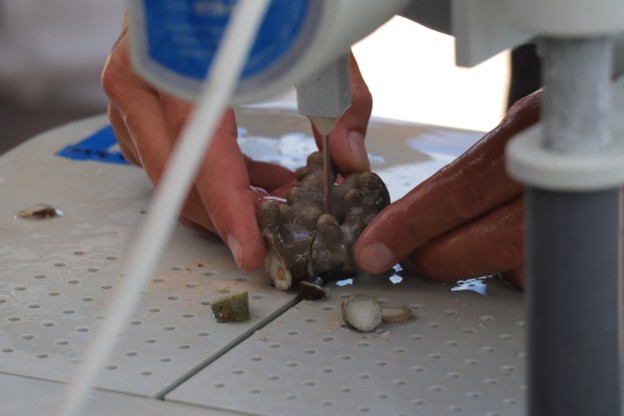
Photo credit: Kuleana Coral Restoration.
Here in Hawaii, I have the privilege of working at one such organization founded by a fishermen, divers, surfers and scientists, called Kuleana Coral Restoration. In Hawaiian, the definition of Kuleana is a responsibility to care for the land and the community, it is not a burden but a privilege and it is rooted in reciprocity. You take care of the land, and in turn, it takes care of you.
In Hawaii we are presented with the unique challenge of our coral’s slow growth rate paired with continuous year-round swells, making more traditional restoration methods challenging. Because of this we tend to focus on colonies that have been broken off from the sea floor to reattach them and potentially save decades of growth, or utilize fragmentation to propagate new colonies when this isn’t an option.
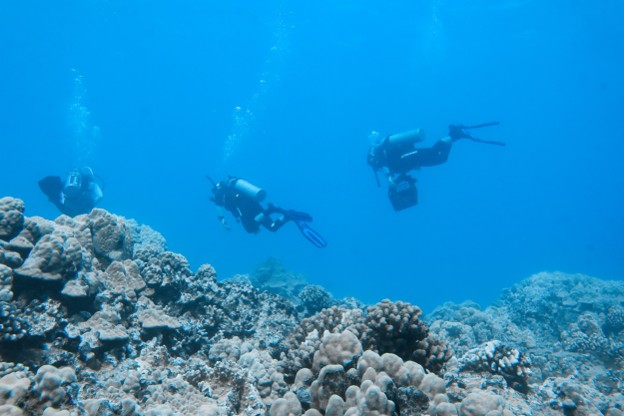
Photo credit: Baylee Jackson, Kuleana Coral Restoration
When we scout sites to restore, it usually looks pretty bleak: barren areas that have small outcrops of living coral. But as we search for and collect corals of opportunity, ones that have been dislodged and have a lower survival rate on their own, a sense of hope returns.
The gratification of successfully transplanting coral fragments and watching an immediate response from the reef’s residents is both fulfilling and addicting. Often as we start planting corals, small fish, and even invertebrates like sea urchins, will come to inspect and even take up immediate residence. Watching the transformation over time is truly rewarding.

Photo credit: Baylee Jackson, Kuleana Coral Restoration
One memorable restoration project was the first time the State of Hawaii requested an emergency coral repair response. This was a joint effort between Kuleana Coral Restoration and the State of Hawaii Department of Aquatic Resources (DAR). There had been an anchor drag through one of the most pristine sections of reef on Oahu’s south shore. We were tasked with assessing and repairing the reef over a large area. Each time I descended from the surface, I felt like a special operative: dropping down to the targeted area and as soon as I hit the bottom it was time to rock and roll because in diving, the deeper you go the less time you have to work. Each breath is deliberate, trying to be as efficient as possible. One of our methods for rescuing the reef was installing pins in the base of the coral and drilling another hole in the ocean floor to glue the pinned coral into. When you drill on land you have the help of gravity to keep your drill centered driving into your object, underwater that’s gone. Throw in surge and current, and suddenly you’re a weightless, upside down ballerina doing pirouettes on a drill point trying to kick and press into the ground because there’s nothing to grab to hold you down.
Despite the challenging work, we worked as a team and the project was a success and hopefully will serve as a proof of concept for future emergency repair response requests if needed.
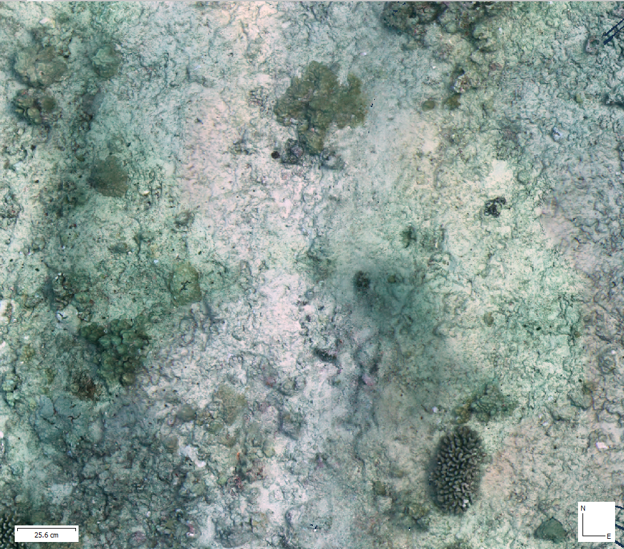
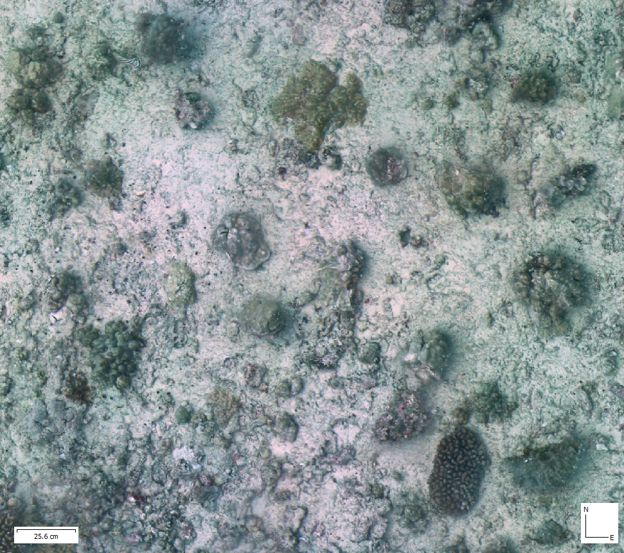
photos courtesy of Kuleana Coral Restoration.
We are continuously working with other partners in refining and coming up with new methods for scalable restoration efforts, but it will take more than a handful of organizations to restore and protect our reefs. It may seem outlandish to think choices made thousands of miles away from a coral reef will make an impact, but they do.
There’s so much you can do to make a collective difference: Support the non-profit organizations on the front lines who rely on federal grants and donations. Write to your lawmakers on the importance of supporting federal agencies like NOAA who provide grants to these non-profit organizations. Participate with Citizens of the Reef at greatreefcenus.org to help analyze coral images right from home. Limit your waste that can make it out to sea. Advocate for limiting the emissions of greenhouse gases that cause climate change and increase carbon sequestering. Support small and local farmers to reduce excess emissions and fertilizer runoff.
If you happen to be visiting or live near a reef, avoid direct contact with the reef and read the fine print on your products labels. The only “reef safe” sunscreen is non-nano zinc that cannot be absorbed into coral’s skin and won’t affect their photosynthesis capabilities. Practice good boating, using mooring systems when available and use anchors in sandy bottoms avoiding hooking on reefs and using enough scope to prevent anchor drag. When fishing, try to use recoverable gear and avoid ditching your gear when possible. If buying seafood, use seafoodwatch.org or fishwatch.gov to seek out sustainable and best practice fisheries.
But if you take anything from this, remember: We are just like coral. We are small as individuals, but when we form a community we can make a lasting global impact.
Sources:
National Oceanic and Atmospheric Administration. Coral Reef Ecosystems. 11 Feb. 2026, https://www.noaa.gov/education/resource-collections/marine-life/coral-reef-ecosystems.
National Oceanic and Atmospheric Administration. Office for Coastal Management.
https://coast.noaa.gov/states/fast-facts/coral-reefs.html accessed on May 13th, 2026
https://oceanservice.noaa.gov/facts/coralreef-climate.html accessed on May 13th, 2026
https://oceanservice.noaa.gov/education/tutorial_corals/coral07_importance.html accessed on May 13th, 2026
https://oceanservice.noaa.gov/education/tutorial_corals/coral06_reproduction.html accessed on May 18th, 2026
Kuleanacoral.org accessed on May 18th, 2026
Kumulipo text
https://blogs.ksbe.edu/adakina/files/2008/02/kumulipo-text.pdf